


Who Is Jesus Christ? — The Central Question
A five-lesson journey through the Scriptures’ own answer to the most important question ever asked — taught for those who would know Christ, believe in Him, and find in Him the sufficiency for time and eternity.
5 lessons · 35-45 minutes each
Old Testament and New Testament
Taught by Pastor Josh Strelecki
Study guide and printable outline included with each lesson
“In him dwelleth all the fulness of the Godhead bodily.” — Colossians 2:9
Why This Question?
No question matters more. How a person answers it determines not only what they believe about a single historical figure, but where they will spend eternity. Pastor Josh Strelecki opens this course with the conviction that the world is full of false views of Jesus — that He was a great moral teacher, a benevolent prophet, a social reformer, one divine entity among many, a mere creature. Scripture permits none of those answers. The Bible’s testimony is singular and exclusive: Jesus Christ is God in the flesh, the eternal second member of the triune Godhead, who came to die and rise again so that everyone who believes might receive eternal life.
This course walks the question from the ground up. It begins by establishing who the God of the Bible is, because no one can rightly understand who Jesus is without first knowing what kind of God claims to have become a man. From there the course examines Jesus’ authority, His claims about Himself, the responses of those who met Him face to face, and finally the sufficiency of His death and resurrection. Each lesson builds on the one before it, and together they leave no honest reader with a third option.
The teaching is doctrinal but personal. It is not a survey of historical opinions about Jesus — it is the witness of Scripture concerning the One who said, “I and my Father are one,” and who said it to be either believed or denied. Pastor Josh’s appeal is the same in every lesson: trust the Lord Jesus Christ today.
Five Questions, One Christ
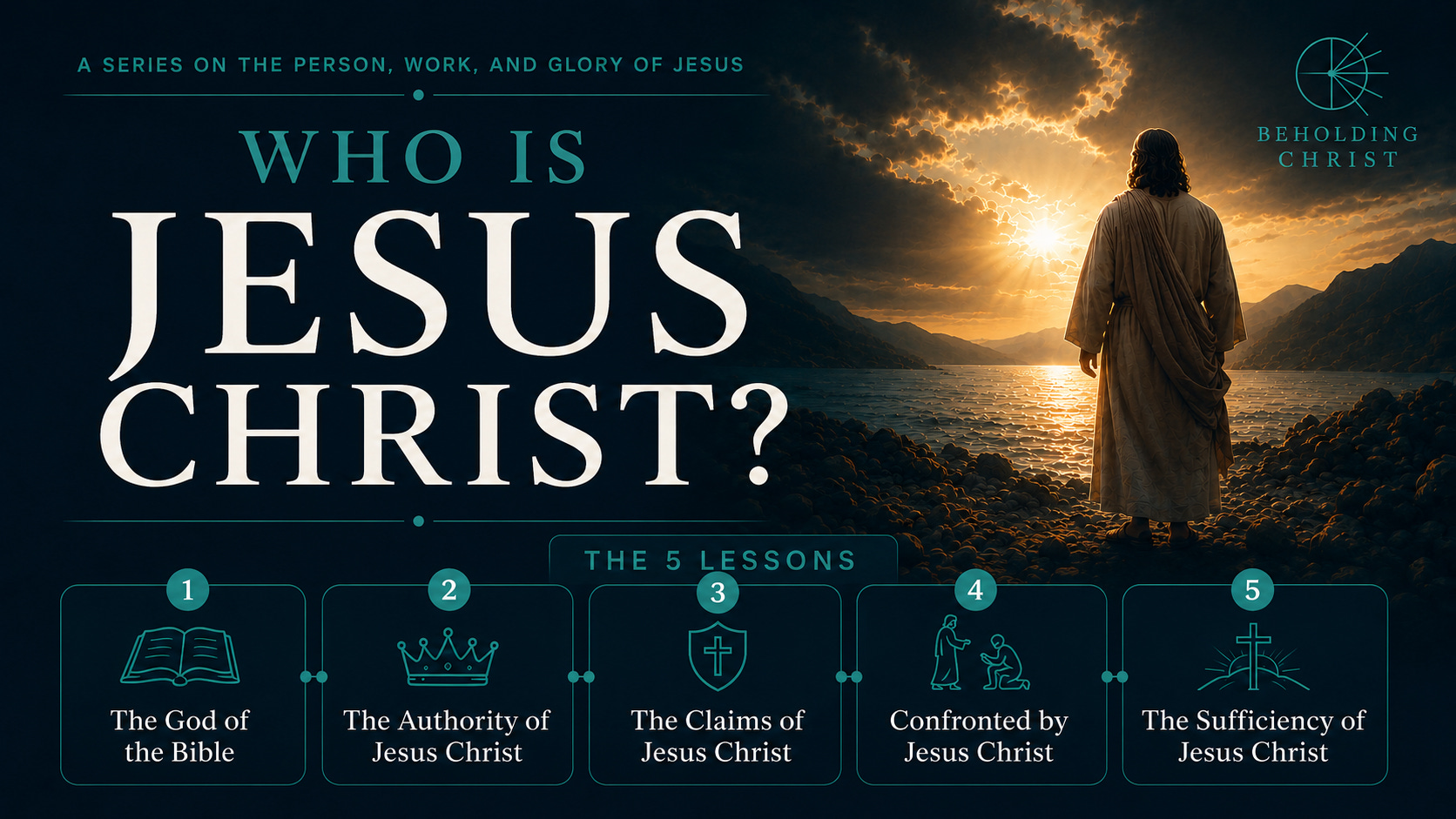
The course is built on five questions, each answered by a single lesson. They progress in order — foundation, demonstration, declaration, response, application. Together they form the full Scriptural case for who Jesus Christ is.
Question One — Who is the God of the Bible? (Lesson 1) Before the question of Jesus can be rightly asked, the question of God must be answered. Scripture reveals one God in three persons — Creator, triune, holy, good, love, and saving — and Jesus is the second member of that Godhead.
Question Two — What does Jesus do? (Lesson 2) The works of Christ testify to His identity. He has authority over devils, over creation, and over sin and disease — works that only God can do, performed by the One in whom all the fulness of the Godhead dwells bodily.
Question Three — What does Jesus claim about Himself? (Lesson 3) From Caesarea Philippi to the high priest’s court, Jesus claims the divine name, equality with the Father, pre-existence, and absolute authority. His claims permit only two conclusions: He is an egomaniac, or He is God.
Question Four — How did people respond when they met Him? (Lesson 4) Six men were confronted by Jesus and were never the same — Nathanael, Thomas, the writer of Hebrews, Peter, John, and Paul. Their confessions form a witness to every reader who has not yet seen Him but is called to believe.
Question Five — Why did He come? (Lesson 5) If Jesus is God, why did He come to die? Because only God could bear the eternal punishment for sin. The cross is where God’s perfect justice and perfect love meet, and in Christ the believer finds all sufficiency in all things.
What You Will Learn
By the end of this course, you will be able to:
State the biblical case for the deity of Jesus Christ — from passages that call Him God, passages where He calls Himself God, titles and attributes shared by the Father and the Son, and works that only God can do.
Trace the relationship between the God of the Bible and the Person of Christ — including the doctrine of the triune Godhead and how Jesus fits as the eternal second member.
Recognize and answer the false views of Jesus — moral teacher, benevolent prophet, one of many divine beings, mere creature — and explain why Scripture itself rules out every middle position.
Engage the major “I AM” claims of John’s Gospel and connect them to Exodus 3:14, the divine name first revealed to Moses at the burning bush.
Read the Gospels with new eyes — alert to the moments where individuals confronted by Christ gave the response Scripture commends, and what their confessions teach about your own.
Understand why the One who died on the cross had to be God — and why the sufficiency of Christ’s atonement rests entirely on the deity of the Christ who hung there.
Articulate the gospel of Jesus Christ clearly — His death, burial, and resurrection — and the call to receive it by faith alone.
Lesson-by-Lesson Breakdown
Foundation
Lesson 1 — The God of the Bible: Who Is He?
Hebrews 1:1–4; Colossians 2:9; John 1:1; Genesis 1; Isaiah 6:3; 1 John 4:8; 1 Timothy 2:3–5
The course opens with the most important question reframed: before Jesus, who is the God of the Bible? Pastor Josh walks through six features of the God who has revealed Himself in Scripture — Creator, triune, holy, good, love, and saving. Hebrews 1, Colossians 2:9, and John 1:1 give a first glimpse of the result toward which the entire course points: Jesus is God, the express image of His person, the One in whom all the fulness of the Godhead dwells bodily. The lesson sets the doctrinal floor on which everything that follows is built.
Demonstration
Lesson 2 — The Authority of Jesus Christ
Philippians 2:5–6; John 5:18; Colossians 2:9; John 1:1–3; Exodus 3:14; Mark 1:21–27; Matthew 14:22–33; Mark 2:1–12
Lesson 2 turns from the question of God to the works of Jesus. Five lines of biblical evidence are presented: passages that call Jesus God, passages where He calls Himself God, titles and attributes shared by the Father and the Son, works that only God can do, and the manifestation of His authority over devils, over creation, and over sin and disease. The disciples’ response in Matthew 14:33 — “Of a truth thou art the Son of God” — is the only honest answer Scripture permits.
Declaration
Lesson 3 — The Claims of Jesus Christ
Matthew 16:13–20; Daniel 7:13–14; John 5:17–18; John 8:23–58; John 17:5; John 18:4–6; Mark 14:61–62; John 10:30
The third lesson moves to the words of Christ Himself. At Caesarea Philippi He presses His disciples on the question of His identity. The title “Son of Man,” drawn from Daniel 7, is not a humble denial of deity but a claim to receive an everlasting kingdom from the Ancient of Days. Pastor Josh walks the great “I AM” claims of John’s Gospel and the climactic moment in John 18, where Christ’s “I am he” causes a Roman arresting party to fall backward to the ground. The lesson closes with the trilemma: egomaniac or God. There is no middle ground.
Response
Lesson 4 — Confronted by Jesus Christ
John 1:43–51; John 20:24–29; Hebrews 1:1–8; Luke 5:1–11; Revelation 1:17–18; Acts 9:1–20
Six men met Jesus face to face and were never the same. Nathanael confessed Him as the Son of God. Thomas, the doubter, confessed Him as “my Lord and my God.” The writer of Hebrews recorded the Father’s own address to the Son: “Thy throne, O God, is for ever and ever.” Peter fell at His knees in conviction of his sin. John, in the apocalyptic vision, fell at His feet as dead. And Paul — the persecutor — became the proclaimer. Their confessions form a witness to every reader who has not seen Him but is called to believe.
Application
Lesson 5 — The Sufficiency of Jesus Christ
John 8:21–24; Luke 5:17–26; John 5:22–30; Romans 2:16; John 3:14–18; Romans 3:23–26; 2 Corinthians 5:21; 2 Corinthians 9:8
The final lesson answers the question that follows from everything that has come before: if Jesus is God, why did He come to die? Pastor Josh walks through Christ’s teaching on sin, His teaching on judgment, and the necessity of the cross. The judge-and-murderer illustration shows why love without justice is injustice — and why the cross is the only place where God’s perfect justice and perfect love meet without compromise. The series closes on 2 Corinthians 9:8: Christ is sufficient not only for eternal life, but for every grace needed for every good work in this life.
Who This Course Is For
The honest seeker who has heard many things about Jesus and wants to know what Scripture actually says. This course does not summarize cultural opinions — it walks the Bible’s own witness from start to finish and lets the reader weigh the evidence for themselves.
The new believer who needs to know who they have just trusted. If you have called on the name of Christ but feel uncertain about His identity, His claims, or why His death matters, this course will give you the doctrinal anchor every Christian life is meant to rest on.
The doubter who, like Thomas, finds it hard to believe without seeing. Pastor Josh takes the doubter seriously — and points to the One who said, “Blessed are they that have not seen, and yet have believed.”
The teacher or evangelist who needs to articulate the deity, claims, and sufficiency of Christ clearly. Each lesson includes a full study guide with discussion questions, a lecture outline, a memory verse, and a printable outline for the student. The course is built to be taught as well as studied.
Begin the Course
“And we know that the Son of God is come, and hath given us an understanding, that we may know him that is true, and we are in him that is true, even in his Son Jesus Christ. This is the true God, and eternal life.” — 1 John 5:20
There is no more important question, and there is no other answer. Jesus Christ is God in the flesh — the One who claimed it, the One whose works testify to it, the One whose confessions across history confirm it, and the One whose cross secured it. Begin Lesson 1 today.