


These large theological terms — justification, righteousness, sanctification, propitiation — are packed with meaning, and it’s easy to let them intimidate instead of instruct. Don’t run from them. Run to them. Learn them. Because what they describe is the whole reason anything changed for you the moment you believed the gospel.
We’ve spent several lessons in this series looking at who we were in Adam — dead to God, alive to sin, named by our master in abomination; under sin’s jurisdiction, owing its wages, guilty before God in condemnation; under the power of darkness, led by a spirit not our own, darkness itself in alienation. Then we looked at the operation of God that moves a person out of all of that and into Christ. Now we turn to what we actually possess on the other side of that operation, starting with justification.
Romans 5:18 sets the two verdicts side by side in a single verse: “Therefore as by the offence of one judgment came upon all men to condemnation; even so by the righteousness of one the free gift came upon all men unto justification of life.” One man’s offense, one verdict, extended to all who are in him. One man’s righteousness, one free gift, extended to all who believe. Not by what you’ve done in either case — only by which man you’re identified with.
So we’ll take this in three parts: what justification actually means, by definition; what propitiation adds to our understanding of it; and three features of what it places you under — grace, forgiveness, and access.
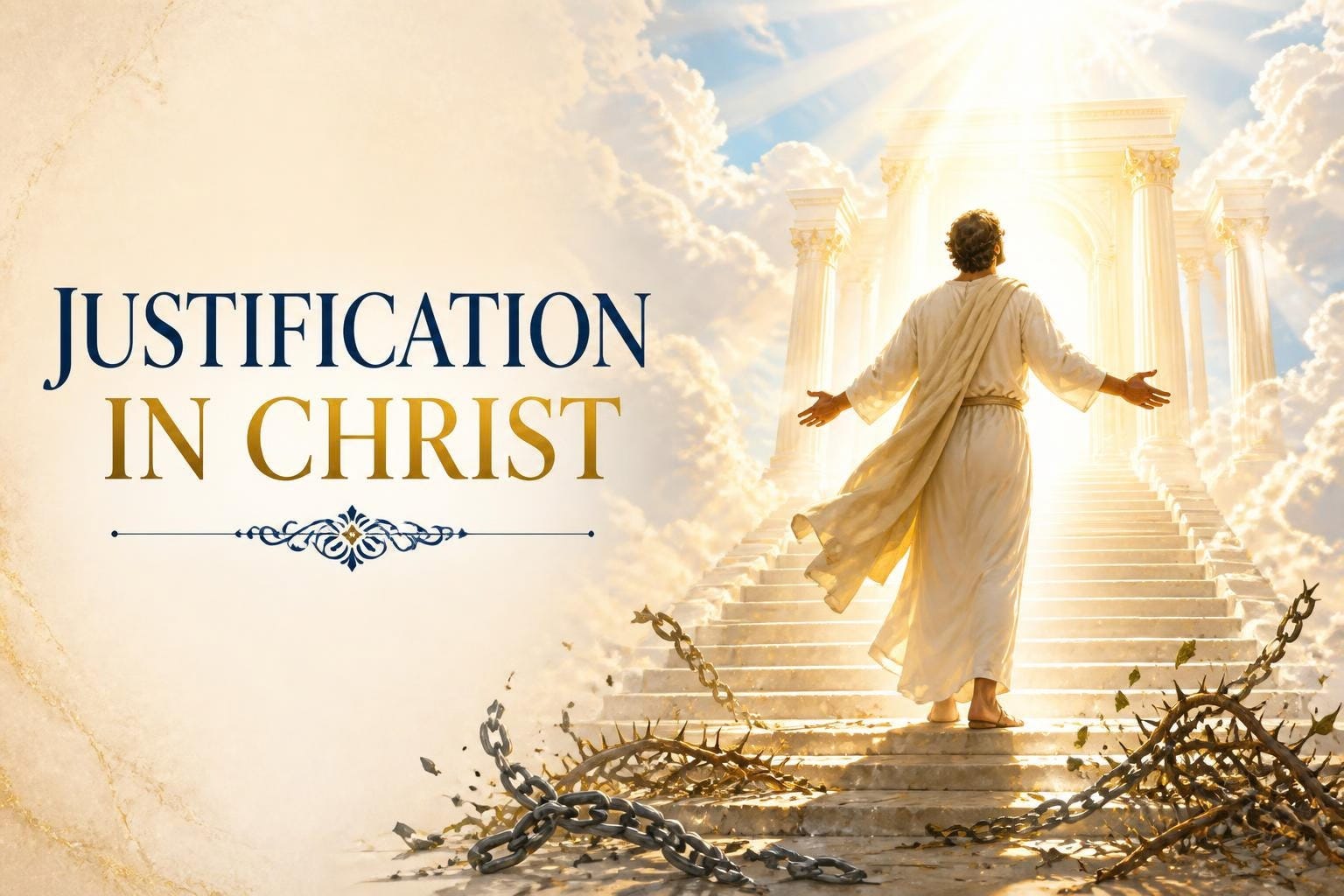
What Justification Means
Justification is essentially the English word for “righteous-fied.” It’s a judicial declaration of righteousness — declared as final, declared as fully rendered. By definition, it’s the remission of sin and the absolution from guilt and punishment, an act of free grace by which God pardons the sinner and accepts him as righteous on account of the atonement of Christ.
Picture a courtroom. You stand on trial, guilty, without excuse, and the verdict is condemnation — a sentence to be paid in full. And then someone comes in and says, I’ll pay their fine. I’ll take their place. But in God’s courtroom, that substitution isn’t allowed from just anyone. It has to come from someone qualified — someone not compromised by the very sin of the one being condemned. That’s what Jesus Christ does. He pays the fine. He takes the place. And the Judge, seeing the person and work of His own Son, seeing the payment made on the cross, is satisfied. He doesn’t just say, you’re free to go. He says, you’re righteous.
How can the Judge say that? Because He isn’t looking at you — He’s looking at what Christ has done. He doesn’t sweep the debt under the rug. Justice has actually been met, which is why He’s not merely permitted to forgive you, but righteous in doing it. No other religion can offer that. A god who simply forgives without His justice being satisfied is a god whose justice has been spurned — forgiveness for the offender, but no justice for the One offended against. The only way both are met in the same verdict is in the person and work of Jesus Christ, where justice is met because we couldn’t meet it, and He did for us.
What Propitiation Adds
This is why the word propitiation matters alongside justification. Romans 3:25 says God “hath set forth [Christ] to be a propitiation through faith in his blood.” Propitiation denotes the satisfaction of His justice — not that God waived His justice, but that it was satisfied. Isaiah 53:11 puts it prophetically: “He shall see the travail of his soul, and shall be satisfied.” And Ezekiel 16:63 gives God’s own words to a rebellious Israel: “When I am pacified toward thee for all that thou hast done.” Pacified. Satisfied. Not because the offense was waived, but because it was met in Christ.
Why does this matter for our union with Him? Because a judge who waives a debt because he has no other choice hands down a reluctant verdict — well, I suppose, or I got paid off, even though justice isn’t really being met. But a judge whose justice has actually been satisfied hands down a verdict with pleasure. Not in spite of justice, but because of it. If God’s justice is truly satisfied in the person and work of His Son, and you are in Him, then your assurance doesn’t rest on a technicality. It rests on the fact that He is genuinely pleased with you — not based on you, but based on Christ.
So righteousness isn’t acquired by degrees. It’s declared. Whole. Complete. In a single moment. And from that moment, it’s never anything less than yours.
Under Grace
That verdict places you under something — a new reign entirely. Romans 6:14: “For sin shall not have dominion over you: for ye are not under the law, but under grace.” To be under grace isn’t simply for grace to be available to you. It’s to be under its dominion, its protection, its reign, as its subject. We saw earlier that under sin named a dominion — not sin merely present in a life, but sin reigning as a master with you as its subject. Now Paul draws the same legal line in the other direction: you’re under grace. Under sin and under law both describe a reign you’ve been removed from. This is how God sees you — not just a record cleared, but a new dominion entirely, and you’re safe inside it.
2 Corinthians 9:8 describes the nature of this reign: “God is able to make all grace abound toward you; that ye, always having all sufficiency in all things, may abound to every good work.” All grace. Always. Not sometimes, not in degrees, not limping along. The same “no difference” that once leveled every man under condemnation now levels every believer under this grace. Sin’s jurisdiction had no exceptions — you were simply born under it. Neither does grace’s. You’re born under grace the moment you believe, and that’s the dominion you now live in.
Forgiveness and Access
If He doesn’t forgive you all of your sins, it isn’t a true reign of grace. Ephesians 1:7: “In whom we have redemption through his blood, the forgiveness of sins, according to the riches of his grace.” Under the law, Israel brought animal sacrifices on a running account, because the blood of bulls and goats could never actually take away sin — it was a tutor pointing them to Christ. But when Christ sheds His blood, it’s a payment once for all. The forgiveness of your sins is given to you all up front. That’s how you can have assurance. It isn’t that He’s forgotten your sin — it’s an active act of His will to no longer bring it up, because of Jesus Christ. The ledger isn’t managed. It’s reversed.
And He doesn’t forgive you and then send you on your way. Ephesians 1:6: He has made us “accepted,” and notice where — “in the beloved.” The same Son in whom the Father was well pleased, whose soul’s travail satisfied Him, is the one in whom that same satisfaction now reaches you. And Ephesians 3:12: “In whom we have boldness and access with confidence by the faith of him.” Where we once stood before God in Adam with our mouths stopped, guilty, without escape or excuse, we now have boldness, confidence, and access. Accepted in the Beloved.
To the One Still in Adam
Everything here — the verdict, grace’s reign, the forgiveness, the acceptance, the access — traces back to one declaration already spoken. It’s offered to you free because it was paid in full, not because the debt was ever small, but because He’s just that great. What are you going to do with it? There’s no way attending church can get you to heaven. There’s no amount of money you could give that would justify you before God. There’s no amount of works that can pay a sin debt — at best they only mingle with more sin going forward. You need Jesus Christ. You’ve likely been treating acceptance with God as something to qualify for, when the verdict was already spoken: condemned. The only remaining question is whether you’ll receive His verdict of righteousness on His terms, or keep trying to earn what was never for sale. Jesus Christ bore your condemnation, paid your wages, and was raised the third day so that His justification could become yours. If you’ve never believed in what He’s done, today is the day of salvation.
To the One Already in Christ
This verdict, spoken, final, already in force — it’s yours. Familiarity with the doctrine must never be allowed to shrink the size of what you were actually given. You’re not almost condemned. You’re not almost accepted. Let your own thinking about yourself finally catch up to how God already knows you. Remember, you’re no longer under sin’s dominion. Remember, you no longer owe sin’s wages. Remember sin’s guilt, and that you are no longer guilty before God, because of Jesus Christ. And let this truth do its ongoing work — not as information you already knew, but as worship, something you stir up and remember, so that gratitude, not performance, becomes what moves you to live for Him.
Look Up,
— Josh Strelecki, Pastor-Teacher
This is the sixth article from Justification in Christ Lesson 6 in a ten-part study on Union in Christ at Twin Cities Grace Fellowship. Next up: sanctification in Christ — more teaching like this at beholding-christ.com.