


Saved by Grace, but What Is It For?
We come now to the cream of the crop at the end of this series on our union in Christ. What is this whole change and transformation, the moment we believe the gospel, unto? What is it for? What is the purpose of it all?
We have seen who we were in Adam: condemnation, the abomination, and the alienation. We have seen the operation of God that took us from Adam and placed us into Jesus Christ. And we have seen what we have in Him: justification, sanctification, and glorification. Everything that we need to be saved from, and that we need to still be saved from, we have in Jesus Christ by virtue of who He’s made us to be in Him.
Knowing who we are in Christ, and knowing what we possess and the provisions, is designed to produce inward blessings: peace with God, joy, rejoicing, comfort, strength, patience. But simply put, it’s not supposed to stay there. Just as our identity in Adam did not stay with lustful thoughts, but rather deeds of the body, evil deeds, so too our identity in Christ is not supposed to stay there.
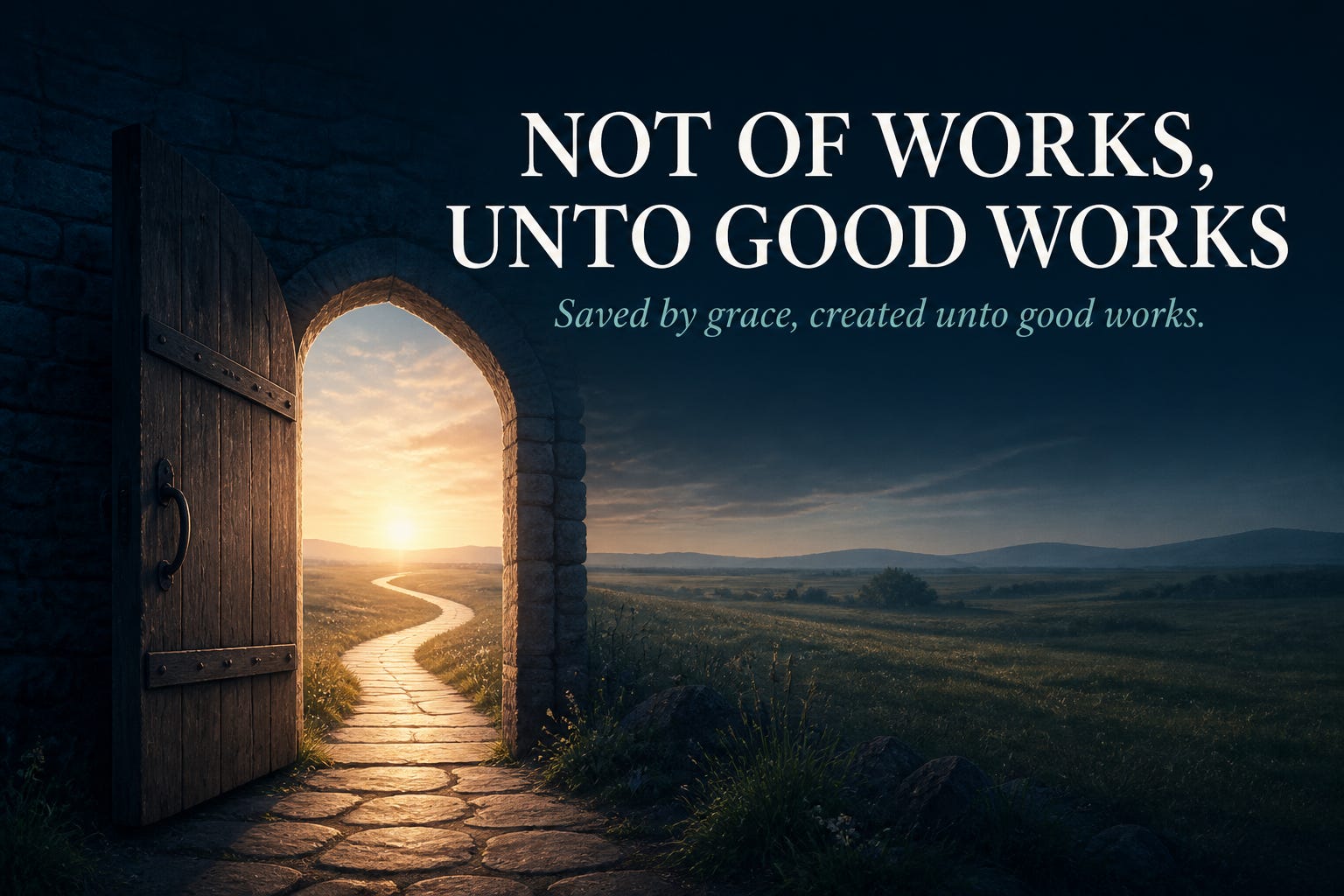
Identity Was Never Meant to Stay in the Mind
That is the burden of this article. If we leave our identity in Christ as knowledge alone, it will never leave the mind. Lived out, it will utilize the body in which it resides, and it will manifest a life that is not our own. It will manifest us glorifying God, both in word and deed. Knowing that we are holy in Christ is meant to lead us to perfect holiness, and imputed righteousness is meant to bear the fruits of righteousness. It is what it is in and of itself, but it is to produce more.
Come with me to Ephesians chapter 2, and read verses 8 through 10.
For by grace are you saved through faith, and that not of yourselves, it is the gift of God, not of works, lest any man should boast. For we are his workmanship, created in Christ Jesus unto good works, which God hath before ordained that we should walk in them. (Ephesians 2:8–10)
Not of Works, and Yet Unto Good Works
Notice the drastic change from verse 8 to verse 10. In verse 8, Paul wants to clarify that issue of “through faith,” and so he says, “And that not of yourselves.” Faith is non-meritorious. It is something you do that has no merit, because faith is trusting in something other than yourself. It is the gift of God, “not of works, lest any man should boast.” If our salvation is of ourselves, if it is of works, then we have something to boast about. But this salvation is by God’s grace, and therefore we cannot boast.
But in verse 10 he brings up works again, in a completely different context in one sense, even though the context remains. “For we are His workmanship, created in Christ Jesus.” If it is of Him and His grace, if it is His gift and not something we work for, then truly we are His workmanship. And then notice those next three words: “Unto good works.”
Notice also the difference between works in verse 9 and good works in verse 10. That implies, and we can back this up with Romans chapter 3, that the works done prior to being in Christ Jesus unto God are not good works. There are none righteous, no, not one, and there is none that doeth good, no, not one. There is one that is good, and that is God. But we are created in Christ Jesus, and thus we are put in a situation now where we can do good works.
The very thing that is done differently is not something that we’ve ultimately done; it’s something that He’s ultimately done, which is the purpose of this whole series. You are not who you thought you were, and you are not doing what you thought you were doing before you were saved. The motivation, the provision and the means by which you do the same thing outwardly has drastically changed. You might have done it before in order to be recognized, or to earn your way to heaven, or by your own wisdom. But you do not do those things now to earn your salvation, because you know you’re already saved. You do them because you’ve been taught the love of God in Christ Jesus, and that love constrains you. That is a world of difference. That is an eternal difference. It is a heavenly to earthly difference, a spiritual to carnal difference.
Created Unto Them, Ordained That We Walk in Them
We are created in Christ Jesus unto good works. We now are able to participate in good works, and not only are we able to, that is the whole purpose of this all. A non-practical theology is not a Pauline theology. The purpose of being a new creature is to be put in a place in which you are unto good works. This is life. This is where abundance is. You want peace, you want charity, you want harmony and unity, you want all the blessing that you’ve been blessed with to be experienced in your life. It is to live in those good works you’ve been created unto.
Notice that this is not an afterthought of God. It is part of His eternal purpose in Christ: “which God hath before ordained that we should walk in them.” We are created unto them, and He has ordained them before that we would walk in them. Created unto them is like you just got started; the purpose is that you would walk in them. And we do not walk in them in order to stay saved, or to maintain our justified status before God. That is a done deal. This is now what we have the honor and privilege to do.
If you’re not considering your life in Christ Jesus, you’re not living in what you’ve been created unto in Him. And so if there’s some discontentment or some inward difficulty in your life, or your relationships aren’t what they ought to be, here is a reason: you are not walking in them. It doesn’t mean it’s easy. But it is the remedy.
The Word Works Effectually in Those Who Believe
How does the inward become outward? It begins with the Word of God working in us. Paul reminds the Thessalonians that when they received the word of God which they heard of him, they received it not as the word of men, but as it is in truth, the word of God, “which effectually worketh also in you that believe” (1 Thessalonians 2:13). It effectually worked in them to justify them and to sanctify them, and there is an ongoing working of it when they believe the word of truth.
When we uphold the authority of God’s Word, and He says to do something, what do you think it’s going to do? It’s going to do it. When He says, if you believe this in order to be comforted, guess what it will do? It will comfort you. But you’ve got to believe it. This is oftentimes an exercise of faith, of how much you uphold your own wisdom, or the world’s wisdom, psychology, philosophy, and so on. It will always work when you believe it.
You might not feel very loved today. But do you know God loves you? Do you know the greatest thing that He could have ever done in all of creation in order to commend and to demonstrate His love for you? He did it for you. He gave His very best to you. He sent you His Son to die on the cross for you poor, miserable sinner, who is deserving not just of a poor, wretched life, but of eternal condemnation. And it’s yours, freely by His grace. If you don’t remember, if you don’t believe it, believe it again, and let it stir up within you this immense weight of the height and depth and breadth and length of His love. We make the gifts, even of God, greater than the giver, when we just need to dwell by faith in Him, the person and work of our Savior, the Lord Jesus Christ.
The Mind of Christ, Worked Out
Look at Philippians 2. The Philippians were a very mature group of believers, yet there were some things that they needed to work out. Paul knew that the only way they were going to work these things out is if the mind of Christ was in their midst. He calls them to be “like-minded, having the same love, being of one accord, of one mind,” and “in lowliness of mind let each esteem other better than themselves.” They have it all in Jesus Christ, but it is not practically being exercised. So he says, “Let this mind be in you, which was also in Christ Jesus.” The very same mind of Christ can be in us. Each. The very same mind.
Then he says, “work out your own salvation with fear and trembling.” Your mind and your fellowship are at stake. I think he is saying that in view of the fellowship and the one accord that are at stake, the salvation here is relational. And notice verse 13, which makes sense in view of all that he said prior to it:
For it is God which worketh in you both to will and to do of his good pleasure. (Philippians 2:13)
Before you can do, He must will. The will is the spring of every deed, and God does not begin with the deed. He begins with the spring. To work to will is to work in the will itself. God doesn’t merely press the believer from without. He moves the inclination from within, so that what was once unwilling is made willing. He doesn’t force you. He doesn’t go against your will. He works in your will to will, so that you see His reasoning, His purpose, the glory, the goodness, all of it, and you’re so moved that now you do. And you can’t say, really, it was my will to do. It was Him working within me.
And God doesn’t stop at the will. He works to do. The inward working is ordered toward the outward deed. This is the hinge of this lesson: what is wrought within is meant to be wrought out. Yet we are responsible. We are to work out our own salvation, but our work is the taking of resources, once not ours, now ours, and working them out. He is the first cause, the prime agent in us working out our own salvation.
This is not just having good feelings about someone, or choosing to think better of them because you have to work with them. This is wholly different. This is gospel-oriented, purpose-driven life, the real kind, the Christ-kind. And what happens when the flesh gets in the way? I’m doing my part, but the other each isn’t doing their part, and therefore I will not do my each. You’ve got a breakdown. But you’re not going to help the situation by not doing what God has called you to do. You will only help the situation when you do what God has called you to do in spite of them. Because that’s the mind of Christ. He did for you what you couldn’t do for yourself in spite of us. It is the complete abandoning of self.
Created in Righteousness and True Holiness
What does it mean to be created in Christ Jesus unto good works? Look at Ephesians chapter 4, verse 24, where Paul says to put on the new man:
Which after God is created in righteousness and true holiness. (Ephesians 4:24)
We have His imputed righteousness, but being created in Christ means we are created in righteousness and in true holiness. What do you think should come from that? Righteousness. Holiness. We have been set apart, and so too our lives are to be set apart.
We are going to be, in view of Ephesians 1, holy and without blame before Him in love. Since we are identified with that, and that is where we are headed, what ought to be our walk? We ought to walk consistent with it. We are not talking about sinless perfection. We are talking about a consistent walk with who we are in Christ, and recognizing that is what we are called unto.
The believer holds Christ’s righteousness as his standing. That is the righteousness reckoned to us. The righteousness we are created in is therefore the righteousness worked out, the mind of Christ being applied to each. We take those things that He says are righteous, and we put them on, and then we live in accord with them. We are to perfect holiness in the fear of God, Paul says in 2 Corinthians 7:1, cleansing ourselves from all filthiness of the flesh and the spirit, motivated by the promises of God in 2 Corinthians 6.
Possess Your Vessel, Yield Your Members
This is where the inward becomes outward, in the body. In 1 Thessalonians 4, Paul says:
For ye know what commandments we gave you by the Lord Jesus. For this is the will of God, even your sanctification, that you should abstain from fornication. (1 Thessalonians 4:2–3)
Fornication here, in my understanding, is the issue of embracing the will of man, embracing the will of the world in your body, and executing its will instead of God’s. It’s a spiritual one. It can lead to physical things. And in verse 4 Paul says that every one of us should know how to possess his vessel in sanctification and honor.
Do you know how to possess your vessel? If it’s God that works in you both to will and to do, according to His good pleasure, then there has to be the intake of His will, and then a responsibility on our part to believe it and to do it, and that is how we walk. You are already sanctified in Christ. He has already glorified you and honored you. And you now possess your vessel consistent with that. And notice what he says: “He therefore that despiseth.” Despise what? What he just said. If you despise it, you’re not despising man, you’re despising God, “who hath also given unto us his Holy Spirit.”
Romans 6:13 adds another layer:
Neither yield ye your members as instruments of unrighteousness unto sin: but yield yourselves unto God, as those that are alive from the dead, and your members as instruments of righteousness unto God. (Romans 6:13)
That same word, instruments, is translated weapons in 2 Corinthians and Ephesians, dealing with spiritual warfare. Here it is the believer’s own internal battle. Who are you going to yield your body to, as weapons against God or weapons against sin and evil? The body is not our master. It is a vessel we are to hold, and we hold it as those that have been bought and are alive unto God (1 Corinthians 6:19–20). We have the responsibility to possess it, and the responsibility to yield it to our commander-in-chief, our head, the Lord Jesus Christ, and to utilize the body in warfare against that which is carnal.
“Isn’t the Victory Already Won?”
Here is where an honest objection arises. Here’s what used to creep into my mind in regards to our camp grace message: Man, if I do anything, I must be doing it out of my flesh. I’m not called to fight. God already did that for me. Christ did that for me. The victory is won. And it is. We’ve got verses for that. But we’ve also got verses about fighting, and we have to make sense of all that.
Look at 2 Corinthians 7:11. There was sin in the Corinthian church, and there was a sorrow to repentance. And here is what that looked like: what carefulness it wrought in them, what clearing of themselves, what indignation, a word used for God’s wrath against sin, and it is now to be in the mind of the believer against their own sin. Then, “what fear, yea, what vehement desire, yea, what zeal,” and then, “yea, what revenge.” You know how you revenge your disobedience? By obedience. You fight.
Both are true. We need to understand that the victory has been won in Christ, but yet the victory is not experienced yet in its fullness. Thus there is still a fight. And we are to utilize the victory we have in Christ to have victory in our life now. This is how our identity is used, not just inwardly, but outwardly.
And that is why the identity does not automatically work. There is a theology out there that will say if you just believe hard enough, then somehow this life is just going to do, and it will be a passive, overwhelming thing that takes place to you and you will just start living godly. If that was the truth, you would not need any of the instructions from our Apostle. You need to be built up, and then you need to live from that identity. You need to think about God’s Word. You need to pray about God’s Word. You need to make decisions in view of God’s Word. And the combination of those things, you’ll begin to see the life of Jesus Christ in a way that you’ve never sought or experienced it. And oftentimes it’s in the difficult things where His life is most manifest in us.
Word and Deed in the Divine Institutions
The way in which we manifest this identity outwardly is going to take place in two things, mainly: word and deed. How you speak, what you speak, and what you do. How you use your time with your words and how you use your time with your deeds. “As we have therefore opportunity, let us do good unto all men, especially unto them who are of the household of faith.” The deeds are the body moving through the day, in the context that God has ordained, doing the deeds that He’s ordained for us to walk in. We do it in the name of the Lord Jesus, and to the profit of others, and not just our own.
We do this in the context of His divine institutions, in marriage, in family, the church, at work, and every other name that is named as our neighbor. We take this mind of Christ and we have it work in us, and it works our will, and it boils up with zeal, and we now go to do something, and we do it in these institutions. You do it as a wife submitting yourself to your own husband. You do it as husbands as you love your wives and are not bitter against them. Children, you do it in obeying your parents in all things, in things that are true and godly. Parents, you do it by not provoking your children to anger.
To your neighbor, love worketh no ill. You seek to live peaceably, and to do that which is right amongst them. At work, if you are a supervisor or manager, you don’t threaten those underneath you. You can instruct, you can inform, you can teach, but you don’t bring down the hammer. You try to reflect your master who is in heaven, Jesus Christ. If you’re an employee, you’re called to obey in all things, not with eye service as men pleasers, but in singleness of heart, fearing God. All of this we’re doing not simply for the other, but first and foremost unto God.
Don’t Let It Stop
The same word ultimately comes to all of us in the various contexts in which we come. Take what Christ has done for you and measure it within the relationships that you’re in. Let it motivate you, let it constrain you, let it work to will in you, and do not let it stop at the will, but do it.
And when you have gone against that time and time and time again, you’ve got to start fighting. You have to start revenging your disobedience. You have to start taking up arms, spiritually speaking. Fight against yourself by taking God’s Word and letting it work in you and believing it. And start fighting against the wisdom of the world, so that you can start functioning in the way that God created you unto these good works. Don’t let it stop.
Look Up,
—Josh Strelecki, Pastor-Teacher
This is article ten in the Union in Christ series, based on Lesson 10, The Uses of Identity Outwardly. You can listen to the full lesson here.
This concluded the Union in Christ series. Next up: Letters to the Nations, beginning with an introduction and overview of the Pauline Epistles and then the journey through Paul’s letters begins chapter-by-chapter starting with
Romans chapter 1.
Wonderful and encouraging lesson. Great way to start the day by listening to it on my way to work. Thank you Pastor Josh!