Ask someone who they are and the answer may change day by day. One day they’re doing great, so they feel accepted. The next day they sin, and they wonder if God can still have them. Ask the culture around us the same question and you’ll hear it dressed up differently — I identify as, I identify with — but underneath the language it’s the same old wandering. A vague sense. A borrowed sense. An identity that rises and falls with feeling, with performance, with whatever is currently the offer.
Thankfully, God’s Word will not leave you there.
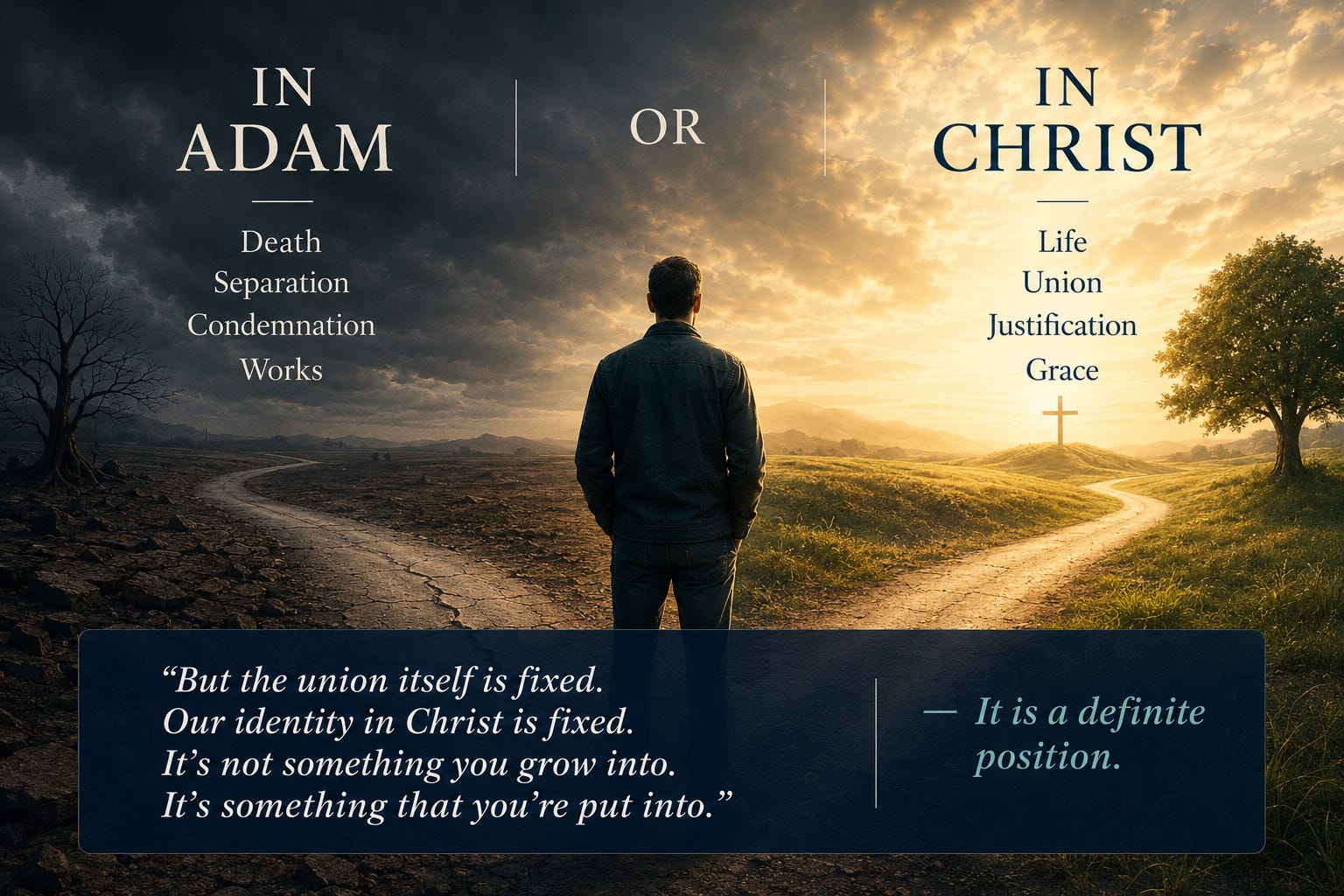
The Bible does not describe your identity in vague or borrowed terms. It reduces every person to one of two unions — in Adam, or in Christ — and if you are in Christ, that position is not something you are growing into. It is something you were put into, and it is fixed.
Four things will show us this, and they’re worth walking through slowly instead of taking my word for it. Your identity is declared, not discovered — you don’t dig it up, God says it. It’s defended, not doubted — there’s an accuser, and there’s an answer. It’s traced to a person, not a performance — one man’s act, not your own effort, decides it. And it’s anchored, not adrift — it holds when everything else in your life is shaking. Then we’ll deal honestly with the objection this doctrine always raises, before we land on what all of this actually means for you, this week, in your own skin.
In Adam, that’s what you’re born into. In Christ, that’s what you’re put into — and it isn’t a matter of degree. Just as at the moment of conception your DNA is already complete, though you’ll spend years growing into what your body will look like, so at the moment of faith your union with Christ is already complete, though you’ll spend a lifetime growing into what that union means. The union is fixed. The walk is lifelong. Don’t confuse the two, and don’t let go of either one.
Declared, Not Discovered
Look at Galatians 3:26-27: “For ye are all the children of God by faith in Christ Jesus. For as many of you as have been baptized into Christ have put on Christ.” Not may be. Not hope to be. Paul writes this to believers at Galatia who were flirting with the law and walking carnally — and he still says of them, plainly, ye are. What made them children of God wasn’t their performance. It was faith in Christ Jesus.
And notice who does the baptizing. Not a man, not water, not a ritual you could later second-guess. Ye have been baptized into Christ. No man can put you there. Only He can. If a man could do it, you’d have every right to question whether he did it right — was it the right water, the right formula, the right moment. But this baptism isn’t performed by hands. It’s performed by God, and it cannot be undone by asking whether it worked.
This is the difference between an identity you assemble and an identity you’re given. You didn’t build this one. You received it. That’s not a small distinction — it’s the whole reason it can hold.
Defended, Not Doubted
Romans 8 pushes the same truth further, into the place where it actually gets tested — under accusation. Verse 16: “The Spirit itself beareth witness with our spirit, that we are the children of God.” Verse 17 follows the logic out: “And if children, then heirs; heirs of God, and joint-heirs with Christ.” Then, later in the chapter, verse 33: “Who shall lay any thing to the charge of God’s elect? It is God that justifieth.”
I’ve sat with believers who told me, through tears, I know I’m forgiven, but I don’t feel it. I’ve felt that myself — I spent years in a system that taught if you sinned a hundred times, you had reason to question whether you were saved at all. And I knew in my heart I had sinned a hundred times. But here’s what I’ve learned to say, to them and to myself: get over the feeling and believe the verse. The accuser will bring up your sin — the same sin, over and over — and God’s answer has never changed from one time to the next. “I justified them.” Not I’m working on it. Not we’ll see how this goes. Justified. Your accusations once had ground. They don’t anymore.
Traced to a Person, Not a Performance
Romans 5 traces the whole question back to its source, and it’s not a source most people expect. Verse 12: “Wherefore, as by one man sin entered into the world, and death by sin; and so death passed upon all men, for that all have sinned.” And verse 15: “But not as the offence, so also is the free gift. For if through the offence of one many be dead, much more the grace of God, and the gift by grace, which is by one man, Jesus Christ, hath abounded unto many.”
Everything Adam did gets applied to everyone in Adam — and you didn’t earn that, you inherited it. Everything Christ did gets applied to everyone in Christ — through a condition, yes, but a condition that isn’t merit. Faith. Nobody stands before God arguing they built their own identity out of good behavior, on either side of the ledger. You didn’t earn your place in Adam and you don’t earn your place in Christ. Both are given. Only one of them is good news.
Anchored, Not Adrift
This is where the doctrine stops being merely comforting and starts being useful, because none of us live in a controlled environment. Paul writes in 2 Corinthians 4:8-9, “We are troubled on every side, yet not distressed; we are perplexed, but not in despair; persecuted, but not forsaken; cast down, but not destroyed.” Notice the difference between the pressure and the outcome. The pressure is real — troubled, perplexed, persecuted, cast down. But the outcome doesn’t follow from the pressure. It follows from the identity.
Suffering has a way of making people ask what they did wrong, as though pain were always evidence of God’s absence. An unbeliever going through hardship has no anchor for that question — nothing underneath the suffering except the suffering itself. But if you are in Christ, the pressure is not the last word on who you are or where you stand, because that was settled before the pressure arrived. You can be cast down without being forsaken, because those two things are not the same thing under God’s grace today - sure, under the law to chastise his people for their disobedience - but not today. You may reap what you sow, but the persecution is not God’s forsaking of you.
The Fair Question
Someone will say — fine, but if my identity is already fixed, what’s stopping me from doing whatever I want? It’s a fair question, the kind worth naming honestly instead of neglecting it. And Paul never leaves it unanswered.
He doesn’t say, you are, therefore do as you please. He says, you are, therefore walk like it. Ephesians 2:10: “For we are his workmanship, created in Christ Jesus unto good works, which God hath before ordained that we should walk in them.” The union is the foundation. The good works are what gets built on it. Take away the identity and you’re left trying to manufacture righteousness out of nothing — that’s legalism. Take away the walk and you’ve turned a settled truth into a license — that’s licentiousness. Paul holds both, refusing either error, and so should we. Identity isn’t the excuse for the walk. It’s the reason the walk is even possible.
What This Means for You
So which one are you in? Not which one do you feel like you’re in on your best day, or your worst — which one are you actually in. If you have never trusted Christ, Scripture doesn’t leave that vague either: you are in Adam, still under the sentence of wrath, still carrying a debt you cannot pay. But the offer stands. Trust in what He did — died for your sins, buried, and raised again — and everything changes, not because you feel different, but because He has said so.
And if you are already in Christ, this week is a good week to stop consulting your feelings for a verdict God already delivered. Stop letting a bad day reopen a settled case. When the accusation comes — and it will come, because it always does — you don’t need a better feeling to answer it. You need a better memory. You need faith. Don’t soon forget. You are not what you were on your worst day this week. You are not what the accuser whispers at midnight. You are what your Father has declared you to be, in His Son, settled once, and never up for renegotiation again.
Look Up,
— Josh Strelecki, Pastor-Teacher
Adapted from the sermon "Union in Christ" (Lesson 1), preached by Josh Strelecki at Twin Cities Grace Fellowship. Listen to the full message here: https://twincitiesgracefellowshi.subspla.sh/8xwkj2r