


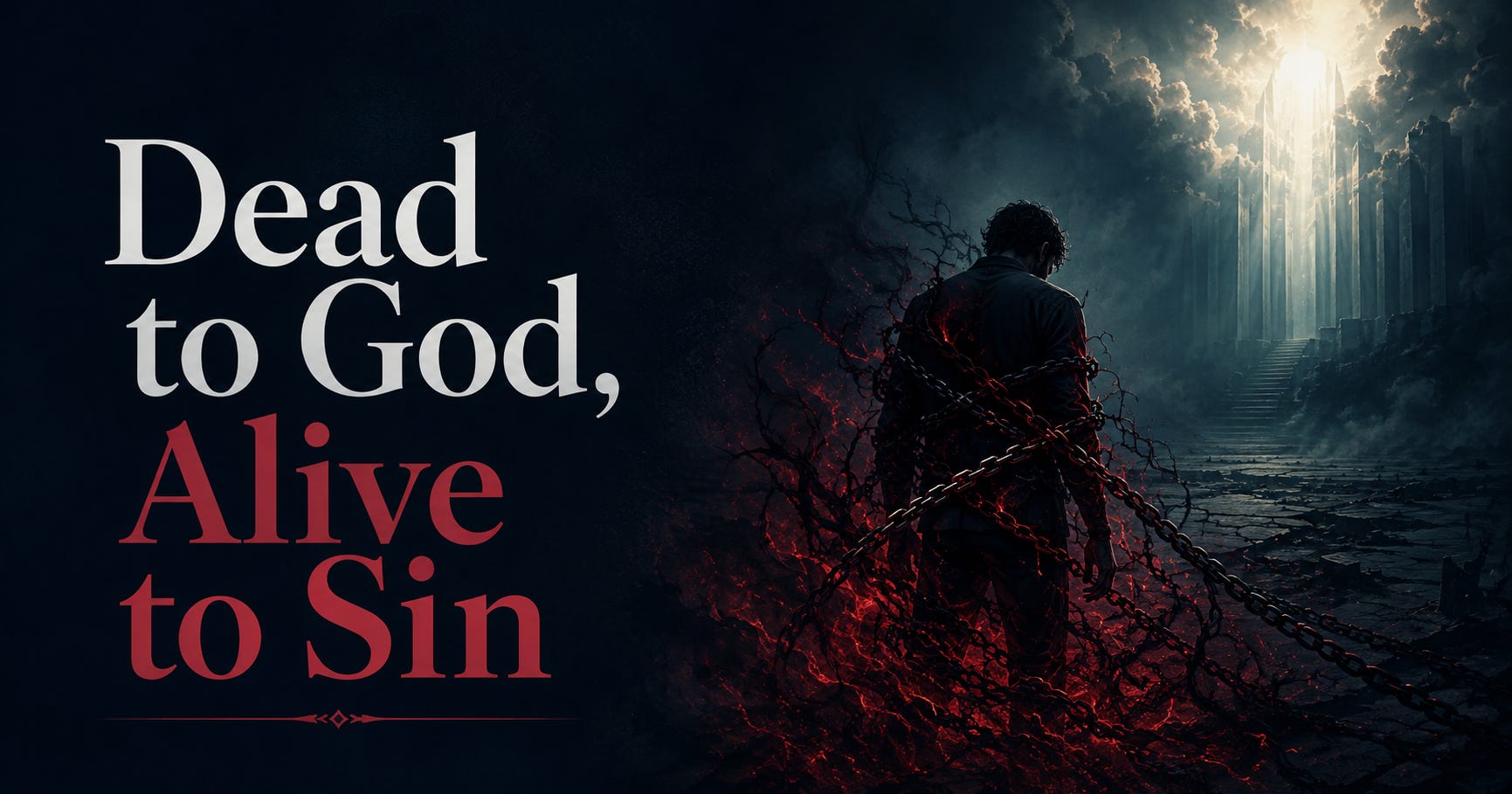
What does Scripture actually say about who you were before Christ? Not a flattering diagnosis. Not “pretty good, but imperfect.” Scripture’s verdict is far more severe: dead to God, alive to sin, and an enemy of God.
This is the second lesson in a ten-lesson series on our identity in Christ. The first lesson laid the groundwork. This lesson, along with the next two, examines our identity in Adam before we turn to the mechanism by which that identity changes, and then to our identity in Christ itself. These next three lessons will be grim. But the doctrine of our union in Christ shines brightly only against the backdrop of who we are by nature.
The goal here is not to consider how you view yourself, how the world views you, or what your own heart or reputation might suggest. What matters is what God says. What is His verdict? Scripture is not vague on this point — and it is, in one sense, the offense of the cross. The cross says: I need to die for you, because you are so vile, so wretched, so wicked, from head to toe, inside and outside, that everything you touch becomes unclean because you are unclean. Christ has to come and do for us what we cannot do for ourselves. People do not like to hear this. They do not want to admit how wretched they are.
Abomination in Adam
Titus 1:15–16 sets the starting point: “Unto the pure all things are pure: but unto them that are defiled and unbelieving is nothing pure; but even their mind and conscience is defiled. They profess that they know God; but in works they deny him, being abominable, and disobedient, and unto every good work reprobate.”
Paul is writing to Titus about the believers on Crete. He notes that they profess to know God — but a verbal profession doesn’t always mean something. “In works they deny him.” That is their behavior, their conduct, their manner of life. And Paul doesn’t prescribe behavior modification as the remedy. He goes to the root: being abominable. Not merely what they do, but the essence of their being — the core of who they are — is abominable, and so their works deny Him. They are disobedient “unto every good work.” Every good work. Not “over here I need help, but over here I’m good.” As one in Adam, there is abomination — full stop.
There are only two places of union available from God’s perspective: union with Adam (Romans 5) or union with Christ. We are born in Adam by natural birth and natural inheritance. What Adam did gets passed on to us. We inherit it.
Three things are worth seeing here: God’s reckoning of us prior to anything we do is that we are detestable, unclean, profane — biblical words — with an identity with sin so total and so inherent that nothing less than justification, sanctification, and glorification in Christ can meet it.
This matters because most people carry a settled verdict of themselves: not perfect, but decent. “I’m good enough.” How many times has someone responded to the gospel by saying they’re good enough, or better than the next person? That itself is a self-verdict that concedes sin — “I’m better than this person, but I’m not perfect” still means you need forgiveness, a righteousness you don’t possess. And people assume that verdict is shared by God.
Psalm 50:16–17 exposes this: “But unto the wicked God saith, What hast thou to do to declare my statutes...? Seeing thou hatest instruction... when thou sawest a thief, then thou consentedst with him... thou givest thy mouth to evil, and thy tongue frameth deceit... these things hast thou done, and I kept silence.” Verse 21 gives their interpretation of that silence: “Thou thoughtest that I was altogether such a one as thyself.” That’s man making God in his own image — not some equal image, but a sinful one, so that adultery and theft become things God is supposedly fine with, simply because He hasn’t directly spoken. Yet these people had the law. They had the Ten Commandments. They knew what sin was.
If a person never faces God’s actual verdict on them, they will settle for a false one of their own making — and trade Christ’s remedy for religion. This shows up even now: a resurgence of interest in religion, in behavior modification, in self-improvement — anything that doesn’t require being saved, because in their own estimate, they were never that far gone in the first place. But a false self-assessment cannot bear the weight of what the gospel actually cost: a Son crucified, penalty-bearing, substitutionary, on the cross under the wages of sin. None of that makes sense for someone who only needed a little correcting. They don’t need a raising from the dead.
Rightly grasping this is also what produces good works. Ephesians 2 says believers in Christ are God’s workmanship, created in Christ Jesus unto good works — but those works don’t close a gap we’ve invented. They flow from knowing Him and what He has provided. Get the verdict about Adam wrong, and even good works become something we’ve done, something we can take credit for, rather than fruit that stems only from His grace, from beholding Him and being changed. The clear verdict doesn’t just tell us we need forgiveness — it tells us we need a radically new identity, and it becomes the basis of ongoing humility. God is not merely a one-time rescue out of Adam; He is our continual strength and refuge every day we remain in Christ.
Three Features: Dead to God, Alive to Sin, Enemies of God
Ephesians 2:1–3 lays these out together: “And you hath he quickened, who were dead in trespasses and sins; wherein in time past ye walked according to the course of this world... and were by nature the children of wrath, even as others.” Here is a deadness that is nonetheless active — dead in trespasses and sins, yet walking (v. 2). That’s the abomination. Verse 3 adds God’s judicial verdict — condemnation — “children of wrath.” And there is alienation: separation, estrangement, no access to God.
Ephesians 4:17–18 develops the alienation: “That ye henceforth walk not as other Gentiles walk, in the vanity of their mind, having the understanding darkened, being alienated from the life of God through the ignorance that is in them, because of the blindness of their heart.” Their heart blinds them, so they are ignorant of their own alienation — and they mistake that alienation for life itself, because they have pleasure in sin.
Isaiah 1:4–6 gives the illustration of sickness: “The whole head is sick, and the whole heart faint. From the sole of the foot even unto the head there is no soundness in it; but wounds, and bruises, and putrifying sores: they have not been closed, neither bound up, neither mollified with ointment.” This is why, when the Lord comes to earth healing the sick and the blind left and right, it is a teaching and an illustration — real events that also point to His power to address the spiritual sickness of the inner man. He comes not for those who are healthy, but those who are sick — those who understand there is a problem.
Romans 5:16 distinguishes condemnation from the gift: “The judgment was by one to condemnation, but the free gift is of many offences unto justification.” The gift is greater — it deals not only with Adam’s offense but with our own offenses in Adam. Abomination is highlighted before condemnation because Scripture typically presents the identity and its fruit before the judicial verdict against it.
When God saves, He first judicially declares us righteous in Christ, then gives us a whole new identity: instead of abomination, sanctification; instead of condemnation, justification; instead of alienation, glorification — instead of eternal estrangement, immediate access, and one day, a glorified body before Him in love.
Dead to God
The word abomination carries the sense of extreme hatred, detestation, defilement, pollution — evil doctrines and practices that are moral defilements. In Titus 1, Paul describes those who profess to know God while their works deny Him: the profession is intact, but the mind and conscience are defiled, so nothing that follows from that root — however religious it looks — is actually pure. Abomination isn’t a verdict on isolated bad acts. It’s a verdict on the root.
Romans 6:11 states the positive, from which we deduce the prior condition: “Reckon ye also yourselves to be dead indeed unto sin, but alive unto God through Jesus Christ our Lord.” Before that “through Jesus Christ our Lord,” the reality was reversed — dead to God, alive to sin.
Man is not merely flawed toward God. He is dead toward Him. But this deadness is not inactivity — Scripture says he is “dead in his trespasses and sins,” which means he is doing a great deal of trespassing and sinning. The issue isn’t a cessation of activity; it’s the continuation of activity from a dead root — activity that can’t produce anything unto God. And men at large don’t even know they’re dead. They’re hourly active and unaware of their own plight.
Sin does what death cannot: it separates a man, while he is still very much alive, from God, who is the light and life of our lives. Nothing can separate a believer from the love of God — but sin severs relation to God in a man who is not yet in Christ.
James 2:26 defines physical death by comparison: “As the body without the spirit is dead, so faith without works is dead.” Death is separation — of spirit from body. In the same way, to be dead to God is to be wholly separated from Him — spirit, soul, and body (echoing 1 Thessalonians 5’s language of being “wholly” sanctified).
Paul himself is the case study: a religious man, certain of his own righteousness, persecuting the church while believing he was defending God. What he needed wasn’t more religious achievement — he needed to recognize he was a sinner like anyone else, needing to be quickened just as much as everyone else.
Romans 3:9–12 drives this home: “Are we better than they? No, in no wise: for we have before proved both Jews and Gentiles, that they are all under sin... There is none righteous, no, not one: there is none that seeketh after God... there is none that doeth good, no, not one.” Dead men don’t know they are dead — that is precisely what makes them dead, not merely dying. You don’t ask a corpse whether it is a corpse.
Alive to Sin
Being dead to God is only half the diagnosis. The other half is that we are alive to sin. Man isn’t merely capable of sin — he pursues it, runs after it, the way a man runs after what he loves. Sin isn’t merely present in the unregenerate heart; it’s craved, loved, pursued with the passion a starving man brings to food — because to that heart, sin is food.
Romans 6 uses the language of servanthood, and it’s not a servant dragged unwillingly to his master — it’s a servant who loves his master, who runs to sin and calls that running freedom, liberty, progression. Job 15:16 pictures it starkly: “How much more abominable and filthy is man, which drinketh iniquity like water” — the way water is a necessity of life. Proverbs 4:16–17 adds: “They sleep not, except they have done mischief... they eat the bread of wickedness, and drink the wine of violence.”
Romans 6:14–19 develops the servant theme. Verse 16: “Know ye not, that to whom ye yield yourselves servants to obey, his servants ye are to whom ye obey; whether of sin unto death, or of obedience unto righteousness?” Verse 18: “Being then made free from sin, ye became the servants of righteousness” — meaning that before, we were servants of sin. Jesus makes the same point in John 8:34: “Whosoever committeth sin is the servant of sin.” Verse 20: “When ye were the servants of sin, ye were free from righteousness... the end of those things is death.”
Consider the Old Testament picture of the bondservant who, given the chance to walk free, instead says, “I love my master, I don’t want to go out free, I want to live with him the rest of my life” — and has his ear bored through as a mark of devotion. That posture is usually preached toward those who love Christ. But it is the same posture the natural man holds toward sin. Not compelled — consenting. Not merely obeying — loving the one he obeys. It isn’t reluctant compliance; it’s approval, pleasure taken in the very things a man knows condemn him.
Romans 1:32 confirms this: “Who knowing the judgment of God, that they which commit such things are worthy of death, not only do the same, but have pleasure in them that do them.” They know the verdict and delight in it anyway — and delight in others who do likewise, because misery loves company.
Where does this servanthood operate? Romans 7:5 answers: “For when we were in the flesh, the motions of sins, which were by the law, did work in our members to bring forth fruit unto death.” It operates first in the body itself — sin’s motions stirring before a single outward act takes shape. Romans 6:13 calls the members “instruments of unrighteousness” — the same word used of weapons of warfare in Ephesians 6. What should have been offered to God is offered instead to self — to self-service, self-preservation, self-satisfaction. It is, in fact, warfare against God.
Paul calls this “the body of sin,” and two chapters later, “the body of this death.” This is the whole-scope wound pictured in Isaiah 1 — “the whole head... sick... the whole heart faint... no soundness in it.” And because the wound is total, the remedy must match its scope: not partial sanctification, but whole sanctification — spirit, soul, and body. Salvation operates in three tenses: saved from the debt and penalty of sin (dealing with condemnation), saved from the power of sin (dealing with abomination), and saved from the presence of sin (glorification).
The one in Adam is not merely sick with sin — he’s in love with it, even though it’s killing him, even though he’s dead. This isn’t a man merely infected with sin; sin has made him alive to it, and he calls it life. The exact things Scripture condemns, our culture now glorifies openly — nothing new, only unveiled. The one in Adam doesn’t serve sin because he must. He serves it because he loves its wages, even without having tasted them — every appetite fed is a debt collected, and what feels like life is truly death, taking its payment in installments.
Enemies of God
This is the stamp on it all. Romans 5:10 speaks of being “reconciled to God by the death of his Son” — implying the prior state was not merely sin committed and loved, but enmity: identification with sin so complete that our master has named us after his own works. We’re not merely those who commit idolatry — we become idolaters. Not merely those who commit adultery — we’re named adulterers.
1 Corinthians 6:9–10 lists the names: “Know ye not that the unrighteous shall not inherit the kingdom of God? Be not deceived: neither fornicators, nor idolaters, nor adulterers... nor thieves, nor covetous, nor drunkards, nor revilers, nor extortioners, shall inherit the kingdom of God.” Romans 8:7 sharpens it further: “The carnal mind is enmity against God: for it is not subject to the law of God, neither indeed can be.” An enemy is one who is unfriendly, who hates and desires to injure another — a foe, an adversary — which is the very meaning of the name Satan.
Iniquity was first found not in Adam, but in Lucifer — lifted in pride, and rather than taking that iniquity to his Father, he cultivated it, increased it, trafficked it, until it reached Adam and Eve. That which originated in him — the “seed of evildoers” of Isaiah 1 — is now in Adam and passed to everyone after him. Our father, apart from Christ, is not God the Father but the father of the lie. And the servant of sin embraces the name given him: “I’m an adulterer, I’m a fornicator, and there’s nothing you can do about it” — loving the wages of sin without tasting them.
This adversarial posture is not confined to the mind. Genesis says every imagination of the heart was only evil continually. Colossians 1:21 speaks of being “alienated and enemies in your mind by wicked works.” Psalm 10:4 notes it even in outward bearing: “The wicked, through the pride of his countenance, will not seek after God.” And in activity — “none righteous... none doeth good” — they earn the name: enemies, fornicators, the covetous, the whoremonger, and they forfeit the inheritance of the kingdom of God’s dear Son.
Psalm 51:5 completes the picture: “Behold, I was shapen in iniquity; and in sin did my mother conceive me.” Job asks, “How can a man who is born of a woman be clean?” We are born in Adam, servants to the sin whose name follows us, children of the father the Scriptures identify with sin and iniquity.
The Remedy
These are the three features of abomination in Adam: dead to God, alive to sin, enemies of God. Grim — but useful. Paul later reminds believers in Titus 3 not to forget what they once were, hateful and hating one another, until the grace and love of God appeared and changed that. It’s only by that same grace that it changes now, and believers become the lens and the manifestation of it to those around them.
Consider the Old Testament leper — unclean, unable to approach God, required to call out “unclean, unclean” and keep his distance, with the priest able only to identify the disease, not heal it. In the same way, sin leaves us with no one able to take it away — until the Lord Jesus Christ comes. And unlike the priest, when He touches the leper, He does not become unclean; He cleanses the leper. He is the way, the truth, and the life — there is no other name under heaven whereby we must be saved.
If the clarity of your predicament in Adam is not yet apparent, believe what Scripture makes plain: it is all there, and it is not a diagnosis without a remedy. He will not take you as you are — you are an abomination to Him, condemned, alienated — but He comes to you, and provides the way for you to come to Him. Give up your own righteousness; Scripture calls it filthy rags. Whatever you might bring to Him as though it could save you, He strikes down and replaces with the true remedy.
There is no promise of another day. The hope found in Jesus Christ, grounded in His resurrection from the dead, stands unlike anything any other religion offers — a hope that stabilizes, strengthens, and comforts through every trial, until sorrow and tears are wiped away and swallowed up in victory, and joy and true pleasures remain forevermore in the presence of our God and King.
Look Up,
—Josh Strelecki, Pastor-Teacher