


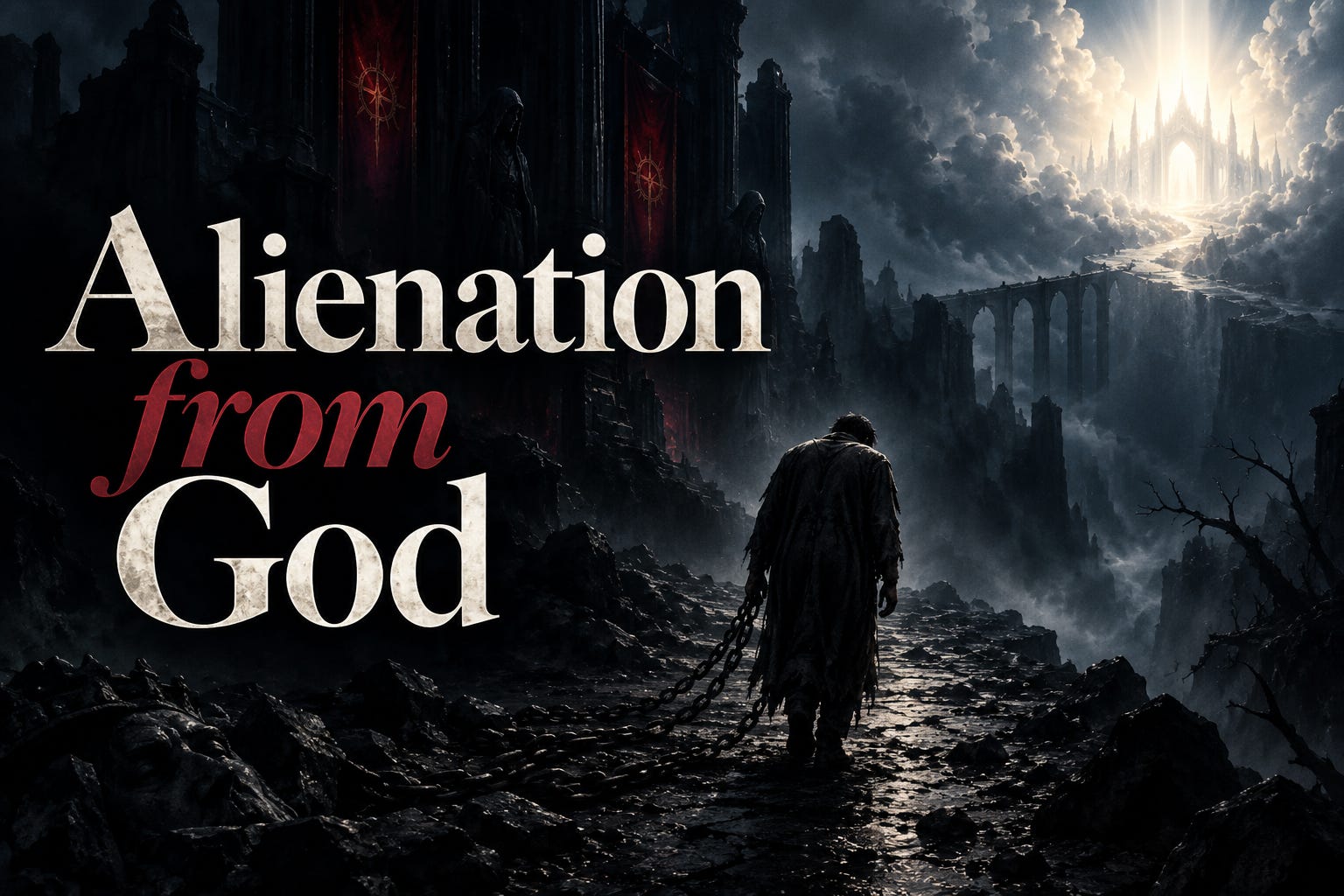
Alienation is the complete estrangement from God as His enemy. It’s a wholesale abandonment — a walking in darkness, with darkness, and toward darkness, until one is wholly identified, not merely as producing the works of darkness, but as darkness itself. Darkness personified. That’s what we were in Adam. And darkness, at its root, is the absence of light. The absence of God. There’s no God-spark here. No residue of Him left to find. This is complete abandonment.
There’s a false assumption people carry, and it isn’t merely ignorance of God. It’s an embraced ignorance — very studious, very knowledgeable ignorance of God. So we’re going to take this in four parts: first, what alienation is, and then three features of it — under the power of darkness, led by the spirit of this world, and darkness itself.
What Alienation Is
Paul writes in Ephesians 4:17-19 that Gentiles walk “in the vanity of their mind, having the understanding darkened, being alienated from the life of God through the ignorance that is in them, because of the blindness of their heart: who being past feeling, have given themselves over unto lasciviousness, to work all uncleanness with greediness.”
We’re not left to speculation about how the world walks. We’re given a very precise diagnosis of the darkness that prevails — not physical darkness under the sun, but the darkness that dwells in the hearts and minds of men. He starts with the vanity of their mind. It’s not that they don’t have a mind, or that they don’t exercise it. Their mind dabbles in and engages in vanity. It’s useless. It’s empty. It’s purposeless. It has no value in how they exercise the very faculty God gave them.
Then he says, having the understanding darkened. They do not have the understanding of God. They do not have an understanding of themselves or of how God made them to operate. And why is the understanding darkened? Because they’re alienated from the life of God through the ignorance that is in them — not ignorance God gave them, but ignorance they embrace. And why the ignorance and the alienation? Because of the blindness of their heart. Their heart, their affections, their desires, their pursuits — blinded. They don’t see what they ought to see.
He goes further in verse 19: past feeling. They’re blind, they’re darkened, it’s vain — and it’s not pretty. This is like going to a doctor, feeling a little sick, and being told you have stage-four cancer in your liver, your lungs, your heart, everywhere, and your brain is about to shut down. You have no hope. That is the spiritual reality every person is born into, and what the world at large is still a part of.
Webster’s 1828 dictionary gives alienation four senses: a legal transfer of title, the state of being estranged, a withdrawing of the heart’s affections, and — strikingly — delirium, derangement of the mental faculties, insanity. Paul’s language draws on nearly all four at once. This is biblical psychology. You don’t need to go to a psychologist about your individual spiritual problems. You need to go to the Word of God and learn what you were naturally a part of, and see how your inward faculties work, and how you’ve used them against yourself.
Under the Power of Darkness
Colossians 1:13 says God “hath delivered us from the power of darkness, and hath translated us into the kingdom of his dear Son.” We’ve already seen sin’s jurisdiction. But there’s a dominion within that jurisdiction. Not only do we, as servants of sin, commit those things — the power of darkness is the master’s own education, his teaching, for us to continue embracing sin. It’s the reason, the cause, the knowledge behind the obedience. It’s the same territory as sin’s jurisdiction, just looked at from a different angle — what makes the jurisdiction hostile to God in every particular aspect. It’s a governing force. It’s a mechanism. It’s the engine. It’s the weapon. It’s what makes this thing persist and gives it motion. And the one who reigns in this dominion, the prince of the power of the air, rules this territory and wields the sword of darkness over us so that we continue to cater to it — appealing to us, working to keep us content in it.
Ephesians 6:12 widens the scope: “We wrestle not against flesh and blood, but against principalities, against powers, against the rulers of the darkness of this world, against spiritual wickedness in high places.” Ephesians 2:2 names a single individual — the prince of the power of the air. But here we see rulers, plural. It’s not just an individual. There’s a whole rank — principalities, powers, rulers of the darkness of this world. It’s layered authority. It’s organized hierarchy.
Led by the Spirit of This World
This prince rules according to “the spirit that now worketh in the children of disobedience” (Ephesians 2:2) — a spirit that educates, that dabbles in everything, because God has thoughts about everything He’s instituted, and this spirit has to counter every one of them. Colossians 2:8 warns believers plainly: “Beware lest any man spoil you through philosophy and vain deceit, after the tradition of men, after the rudiments of the world, and not after Christ.” It comes out through philosophies — vain deceit, not after Jesus Christ, even when it borrows His name. The question is always whether it aligns with the Jesus Christ of the Bible and what He actually said.
The leading of this spirit doesn’t begin with an act. It’s a counterfeit of the Spirit of God. How does the Spirit of God work? He teaches, He gives us words. That’s exactly what the spirit of this world does too, which is why you have to be mindful of what you allow in — the things themselves often aren’t evil, it’s what’s on the airwaves, what’s being taught, how you’re being educated by the spirit of this world. And it works through deceit, which is deliberate. Not an honest mistake — a trick designed to make a lie pass for truth, made harder for the light to penetrate the longer it’s kept hidden instead of addressed.
The Puritan William Greenhill put the pull of it plainly: “there is a great suitableness between the world and our corrupt hearts and natures — its pleasures, profits, and honors suit our fancies and our dispositions exactly, because the world is the devil’s instrument for leading men and women captive, offering each one the particular bait suited to his own taste.” We don’t serve this prince in Adam because he’s strong. We serve him because he’s crafty, and because he’s generous in giving us exactly what we already wanted.
Loving the Darkness
John 3:18-20 puts the sharpest point on all of this. “He that believeth on him is not condemned: but he that believeth not is condemned already, because he hath not believed in the name of the only begotten Son of God.” And then: “This is the condemnation, that light is come into the world, and men loved darkness rather than light, because their deeds were evil.” Notice what it doesn’t say. It doesn’t say men love sin — though they do. It says they love darkness. Light has come into the world to address their sinfulness, but it also has to deal with the darkness they cloak themselves in concerning it. The condemnation isn’t only that you’re a sinner. It’s that you love the very thing that keeps you in it. “Neither cometh to the light, lest his deeds should be reproved.” Pride would rather hold onto the deed than be corrected of it, even when the correction is the only door out.
“I’m Fine”
This is the objection every person still in Adam is quietly making, whether they say it out loud or not — I’m fine, it’s okay. It’s like someone shown a terminal diagnosis, stage four, two days to live, looking at the results and saying, I’m good, while they’re coughing up blood. That’s not confidence. It’s the darkness itself, functioning exactly as it’s designed to — convincing the patient there’s nothing to diagnose. But the doctor, Jesus Christ, doesn’t come along and say you’re fine. He says He came as the great physician to save sinners — to save you, from your terminal spiritual illness. He doesn’t just give the proper diagnosis. He gives the exact remedy.
To the One Still in Adam
Let me be plain about what a Christian actually is — not someone who attends church, or grew up around it, or found something appealing about it. A Christian is someone who believes this: that Jesus Christ is God in the flesh, that He came and died not for the sins of the world in the abstract but for yours specifically, that He was buried, and that He rose again the third day. And that He extends to you what He did on the cross — paying the debt and penalty of your sin — so that if it doesn’t get applied to you, you will pay for it yourself, for all eternity. You don’t have a righteousness before Him. The righteousness of God in Christ has to be given to you. And the only way you receive it — the only way — is not some pseudo-spirituality, not works you’ve conjured up because they once seemed practical. It’s by faith. I trust not myself. Not one iota. I abandon myself, I abandon all my own ways to God, and I only believe in Jesus Christ and what He has done for me. That’s the whole of it. And here’s the wonderful thing about it: it’s simple. It’s so simple. Because He did all the work. It only takes our own flesh and our own thinking to complicate it. A Christian isn’t defined by attending church or finding something appealing in it — it’s what you believe about Jesus Christ and what He’s done concerning your sin.
To the One Already in Christ
We don’t get to assume union with Christ makes us immune to this same darkness. We can still fall victim to the world’s alienation from God — still generate our own opinions and conclusions out of our own greediness rather than out of what God has said, still mistake a self-generated sense of pleasing God for actual faith in Him. What’s at stake in both cases is the same thing: the authority of Scripture, the authority of the Spirit, against a darkness that always insists it can see just fine.
We were sometimes darkness, Paul says — not merely once in darkness, but darkness, fully identified with it, the same way sin fully identified us as its servants. But now are we light in the Lord. Our whole identity has changed. Because of Jesus Christ we are light, led by the light so that we might be enlightened truly, and able to propagate that light inwardly in mind and heart and outwardly in works — the same way we once propagated darkness. Hold onto even a little of that light in a world this dark, and it will shine far brighter than you expect.
— Josh Strelecki, Pastor-Teacher
This is the fourth article in a ten-part study on Union in Christ at Twin Cities Grace Fellowship. Next up: the operation of God that moves a person out of Adam and into Christ — more teaching like this at beholding-christ.com.